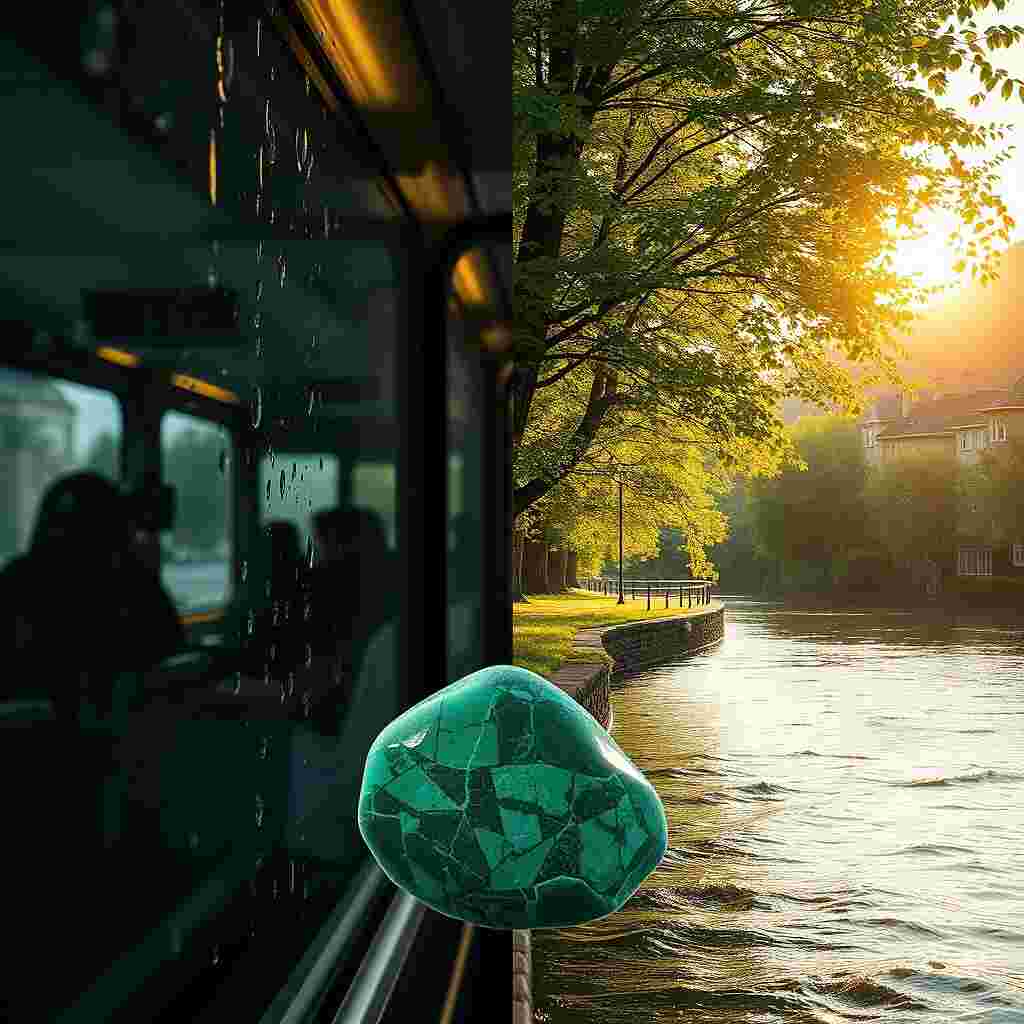
The Earth Changes Like Me, constantly moving and reshaping its surface. From the rugged mountains of Vancouver to the elegant streets of France, my life has been a series of tectonic shifts. I have lived through a difficult divorce, the beauty of adoption, and the battle with breast cancer. Just like the soil beneath our feet, I have been broken, moved, and rebuilt into something stronger.
As a soul geologist, I understand that change is the only constant. We often try to hold on to the past, but The Earth Changes Like Me to remind us that letting go is part of the natural cycle. My journey from a mineralogy engineer to a writer was a necessary erosion of my old self. It allowed the hidden crystals of my soul to finally see the light.
Today, I find my Malachite Peace in the realization that every crack in my history was an opportunity for growth. If you are feeling the pressure of change in your own life, remember that even the most beautiful diamonds were formed under immense heat and stress. You are not breaking; you are transforming. Trust your own internal geology and embrace the new landscape that is forming in your heart.
Zemlja se mijenja kao i ja
Kako sam preživjela tektonski pomak svoje duše
Kažu da su dijamanti samo komadi ugljena koji su se iznimno dobro nosili s pritiskom. Ali ne govore vam o boli tog pritiska. Ne govore vam o trenucima kada se zemlja pod vašim nogama doslovno raspukne, ostavljajući vas da stojite na rubu ponora, gledajući dolje u tamu za koju se čini da nema dna.
Tektonski pomak: Vožnja autobusom kroz kišu
Moj “tektonski pomak” dogodio se u mirnom, šumovitom dijelu Vancouvera. Okruženje je bilo previše mirno za nasilje koje se događalo unutar mog tijela. Sjećam se igala — hladnih, srebrnih i ravnodušnih. Sjećam se doktora koji mi je probadao dojku, ciljajući rak koji se nepozvan uselio u mene. Rađeno je to bez anestezije, sirova fizička bol koja je zrcalila agoniju mog života u tom trenutku.
Nedavno sam napustila supruga koji je moju odanost mijenjao za obmane. Moja djeca nisu bila sa mnom, posljedica njegovih manipulacija koja se osjećala kao sekundarna infekcija u mojoj duši. Bila sam potpuno, zastrašujuće sama.
Dok sam izlazila iz te bolnice, nebo se otvorilo kao da je sa mnom zadržavalo dah. Počela je padati kiša — ona teška, siva kanadska kiša. Nisam imala kišobran, ali nije bilo važno; moje su suze bile vlažnije i vrelije od kiše. Sjedila sam u tom autobusu devedeset minuta, prelazeći s jedne rute na drugu, zureći kroz prozor u grad koji se činio kao strani planet.
Nije me bilo briga tko me gleda. Nije me bilo briga za društvenu “sramotu” žene koja jeca u javnosti. Bila sam najusamljenija osoba na svijetu, vraćajući se u prazan unajmljeni stan na 9. katu u Metrotownu. Ta vožnja autobusom bila je moj silazak u Zemljinu jezgru. Sve što sam znala pretvorilo se u pepeo.
Deveti kat: Tišina kao štit
Kada sam napokon stigla do tog stana, tišina je bila toliko glasna da mi je zujalo u ušima. Stojeći na 9. katu, gledajući svjetla grada, shvatila sam da imam dva izbora: mogla sam dopustiti da me pritisak smrvi u prašinu, ili sam mogla dopustiti da me kristalizira.
U toj praznini počela sam pronalaziti svoju pravu snagu. To nije bila snaga vojnika, već snaga planine. Planina se ne miče kad udari oluja; ona jednostavno stoji. Naučila sam da je tišina, iako se isprva činila kao zatvor, zapravo moj štit. To je bilo jedino mjesto gdje sam mogla čuti istinu bez buke njegovih laži ili statike svjetskog sažaljenja.
Jezgra: Ljubav dvoje spasitelja
Kako usvojeno dijete pronalazi hrabrost da se suoči sa svijetom koji ju je dvaput odbacio? Prvo rođenjem, a zatim brakom? Odgovor je bio u mojoj jezgri.
Sa šest mjeseci bila sam izabrana. Nisam slučajno rođena u obitelji; uvedena sam u nju namjernim činom ljubavi. Moji majka i otac dali su mi sve. Kada mi je rak pokušao uzeti tijelo, posegnula sam u svoje djetinjstvo i pronašla njihove glasove. Mogla sam čuti očev glas — čvrst i ponosan — kako me naziva svojim “snažnim sinom”, nadimkom koji je značio da imam srce ratnika. Mogla sam čuti majku kako mi govori da sam dar, da sam dragocjena i da moram izdržati radi ljubavi koju su ulili u mene. Oni nisu bili samo moji roditelji; bili su moji prvi geolozi. Vidjeli su dijamant u meni puno prije nego što je pritisak počeo. Njihova ljubav bila je temeljna stijena koja nije pukla ni kad je ostatak mog svijeta bio u ruševinama.
Malahitni mir: Geografija oprosta
Danas se magma ohladila. Vrućina bijesa i vatra bolesti ostavile su za sobom krajolik koji je bujan i zelen. Nisam samo preživjela; stigla sam na odredište za koje nikad nisam mislila da je moguće. Živim sada u malom, romantičnom gradu u Francuskoj, gdje rijeka Sauldre teče sa strpljenjem koje sam napokon naučila usvojiti. Zamijenila sam nebodersku usamljenost Metrotowna za toplinu zajednice koja diše.
Moj “Malahitni mir” specifična je nijansa zelene — boja duše koja je zacijelila, ali još uvijek nosi uzorke svoje prošlosti. Nije došao iz konačne, epske bitke; došao je iz tihe odluke da se prestanem boriti protiv struje. Sada provodim dane šetajući uz rijeku, gledajući kako svjetlost pada na vodu i osjećajući duboku zahvalnost za same oluje koje su me slomile. Da se zemlja nije pomaknula, nikada ne bih pronašla ovu skrivenu dolinu mira.
6 faza geologije moje duše:
1. Jezgra: Bezuvjetna, “izabrana” ljubav mojih posvojitelja koja je oblikovala moj temelj.
2. Erupcija: Izdaja u braku i srceparajući gubitak svakodnevnog života s mojom djecom.
3. Potres: Igle i dijagnoza — trenutak kada sam shvatila da je i moje tijelo ratište.
4. Pritisak: Tih 90 minuta vožnje autobusom kroz vankuversku kišu, gdje sam skinula staru kožu.
5. Kristalizacija: Duge noći na 9. katu gdje sam bol pretvarala u poeziju, a laži u istinu.
6. Malahitni mir: Moj život danas uz rijeku Sauldre, gdje sam napokon, neopozivo kod kuće.
Podijelite ovu priču s onima koji se trenutno nalaze u svojoj vožnji autobusom kroz kišu.
La Terre change comme moi
Comment j’ai survécu au bouleversement tectonique de mon âme
On dit que les diamants ne sont que des morceaux de charbon qui ont exceptionnellement bien supporté la pression. Mais on ne vous parle pas de la douleur de cette pression. On ne vous parle pas des moments où la terre sous vos pieds s’ouvre littéralement, vous laissant au bord d’un abîme, regardant vers une obscurité qui semble sans fond.
Le bouleversement tectonique : Un trajet en bus sous la pluie
Mon “bouleversement tectonique” s’est produit dans un quartier boisé et calme de Vancouver. Le cadre était trop paisible pour la violence qui se déroulait à l’intérieur de mon corps. Je me souviens des aiguilles — froides, argentées et indifférentes. Je me souviens du médecin transperçant mon sein, ciblant le cancer qui s’était installé en moi sans y être invité. Cela s’est fait sans anesthésie, une douleur physique brute qui reflétait l’agonie de ma vie à ce moment-là.
Je venais de quitter un mari qui avait échangé ma loyauté contre des tromperies. Mes enfants n’étaient pas avec moi, une conséquence de ses manipulations qui ressemblait à une infection secondaire dans mon âme. J’étais complètement, terriblement seule.
En sortant de cet hôpital, le ciel s’est ouvert comme s’il avait retenu son souffle avec moi. Il a commencé à pleuvoir — cette pluie canadienne, lourde et grise. Je n’avais pas de parapluie, mais peu importait ; mes larmes étaient plus humides et plus chaudes que la pluie. Je me suis assise dans ce bus pendant quatre-vingt-dix minutes, passant d’un itinéraire à l’autre, fixant par la fenêtre une ville qui ressemblait à une planète étrangère. Je me fichais de savoir qui me voyait. J’étais la personne la plus seule au monde, retournant dans un appartement loué vide au 9ème étage à Metrotown. Ce trajet en bus fut ma descente dans le manteau terrestre. Tout ce que je connaissais était réduit en cendres.
Le 9ème étage : Le silence comme bouclier
Quand j’ai finalement atteint cet appartement, le silence était si fort qu’il me faisait bourdonner les oreilles. Debout au 9ème étage, regardant les lumières de la ville, j’ai réalisé que j’avais deux choix : je pouvais laisser la pression m’écraser en poussière, ou je pouvais lui permettre de me cristalliser.
Dans ce vide, j’ai commencé à trouver ma vraie force. Ce n’était pas la force d’un soldat, mais la force d’une montagne. Une montagne ne bouge pas quand la tempête frappe ; elle se tient là, simplement. J’ai appris que le silence, bien qu’il ait d’abord ressemblé à une prison, était en fait mon bouclier. C’était le seul endroit où je pouvais entendre la vérité sans le bruit de ses mensonges ou les parasites de la pitié du monde.
Le noyau : L’amour de deux sauveurs
Comment une enfant adoptée trouve-t-elle le courage d’affronter un monde qui l’a rejetée deux fois ? D’abord à sa naissance, puis par son mariage ? La réponse était dans mon noyau.
À six mois, j’ai été choisie. Je ne suis pas née dans une famille par accident ; j’y ai été amenée par un acte d’amour délibéré. Ma mère et mon père m’ont tout donné. Quand le cancer a essayé de prendre mon corps, j’ai puisé dans mon enfance et j’ai trouvé leurs voix. Je pouvais entendre la voix de mon père — ferme et fier — m’appelant son “fils fort”, un surnom qui signifiait que j’avais un cœur de guerrier. Je pouvais entendre ma mère me dire que j’étais un cadeau. Ils n’étaient pas seulement mes parents ; ils étaient mes premiers géologues. Ils ont vu le diamant en moi bien avant que la pression ne commence. Leur amour était la roche mère qui ne s’est pas fissurée, même quand le reste de mon monde était en ruines.
La paix malachite : La géographie du pardon
Aujourd’hui, le magma a refroidi. La chaleur de la colère et le feu de la maladie ont laissé derrière eux un paysage luxuriant et vert. Je n’ai pas seulement survécu ; je suis arrivée à une destination que je n’aurais jamais crue possible. Je vis maintenant dans une petite ville romantique en France, où la rivière Sauldre coule avec une patience que j’ai enfin appris à adopter.
Ma “paix malachite” est une nuance spécifique de vert — la couleur d’une âme qui a guéri mais qui porte encore les motifs de son passé. Elle n’est pas venue d’une bataille finale et épique ; elle est venue de la décision tranquille de cesser de lutter contre le courant. Maintenant, je passe mes journées à me promener le long de la rivière, et à ressentir un profond sentiment de gratitude pour les tempêtes mêmes qui m’ont brisée. Si la terre n’avait pas bougé, je n’aurais jamais trouvé cette vallée de paix cachée.
Les 6 étapes de la géologie de mon âme :
1. Le noyau : L’amour inconditionnel et “choisi” de mes parents adoptifs qui a formé ma fondation.
2. L’éruption : La trahison d’un mariage et la perte déchirante de la vie quotidienne avec mes enfants.
3. Le tremblement : Les aiguilles et le diagnostic — le moment où j’ai réalisé que mon corps était aussi un champ de bataille.
4. La pression : Ce trajet en bus de 90 minutes sous la pluie de Vancouver, où j’ai mué de mon ancienne peau.
5. La cristallisation : Les longues nuits au 9ème étage où j’ai transformé la douleur en poésie.
6. La paix malachite : Ma vie aujourd’hui près de la Sauldre, où je suis enfin, irrévocablement chez moi.
They say that diamonds are just pieces of coal that handled pressure exceptionally well. But they don’t tell you about the pain of the pressure. They don’t tell you about the moments when the earth under your feet literally splits open, leaving you standing on the edge of an abyss, looking down into a darkness that seems to have no bottom.
The Tectonic Shift: A Bus Ride Through the Rain
My “tectonic shift” happened in a quiet, forested area of Vancouver. The setting was too peaceful for the violence that was happening inside my body. I remember the needles—cold, silver, and indifferent. I remember the doctor piercing my breast, targeting the cancer that had made its home inside me, uninvited. It was done without anesthesia, a raw physical pain that mirrored the agony of my life at that moment.
I had recently left a husband who had traded my loyalty for deceptions. My children were not with me, a consequence of his manipulations that felt like a secondary infection in my soul. I was utterly, terrifyingly alone.
As I walked out of that hospital, the sky opened up as if it had been holding its breath with me. It started to rain—that heavy, grey Canadian rain. I had no umbrella, but it didn’t matter; my tears were wetter and hotter than the rain. I sat in that bus for ninety minutes, crossing from one route to another, staring out the window at a city that felt like a foreign planet.
I didn’t care who saw me. I didn’t care about the social “shame” of a woman sobbing in public. I was the loneliest person in the world, returning to an empty rented apartment on the 9th floor in Metrotown. That bus ride was my descent into the mantle of the earth. Everything I knew had turned to ash.
The Ninth Floor: Silence as a Shield
When I finally reached that apartment, the silence was so loud it made my ears ring. Standing on the 9th floor, looking out at the lights of the city, I realized that I had two choices: I could let the pressure crush me into dust, or I could allow it to crystallize me.
In that emptiness, I began to find my real strength. It wasn’t the strength of a soldier, but the strength of a mountain. A mountain doesn’t move when the storm hits; it simply stands. I learned that silence, though it felt like a prison at first, was actually my shield. It was the only place where I could hear the truth without the noise of his lies or the static of the world’s pity.
The Core: The Love of Two Saviors
How does an adopted child find the courage to face a world that has rejected her twice? First by her birth, and then by her marriage? The answer was in my core.
At six months old, I was chosen. I wasn’t born into a family by accident; I was brought into one by a deliberate act of love. My mother and father gave me everything. When the cancer tried to take my body, I reached back into my childhood and found their voices.
I could hear my father’s voice—firm and proud—calling me his “strong son,” a nickname that meant I had the heart of a warrior. I could hear my mother telling me that I was a gift, that I was precious, and that I had to endure for the sake of the love they had poured into me. They weren’t just my parents; they were my first geologists. They saw the diamond in me long before the pressure started. Their love was the bedrock that didn’t crack, even when the rest of my world was in ruins.
The Malachite Peace: The Geography of Forgiveness
Today, the magma has cooled. The heat of the anger and the fire of the illness have left behind a landscape that is lush and green. I haven’t just survived; I have arrived at a destination I never thought possible.
I live now in a small, romantic town in France, where the Sauldre River flows with a patience I have finally learned to adopt. I traded the skyscraper loneliness of Metrotown for the warmth of a community that breathes.
My “Malachite Peace” is a specific shade of green—the color of a soul that has healed but still carries the patterns of its past. It didn’t come from a final, epic battle; it came from the quiet decision to stop fighting the current. Now, I spend my days walking along the river, watching the way the light hits the water, and feeling a profound sense of gratitude for the very storms that broke me. If the earth hadn’t shifted, I would never have found this hidden valley of peace.
The 6 Stages of My Soul’s Geology:
1. The Core: The unconditional, “chosen” love of my adoptive parents that formed my foundation.
2. The Eruption: The betrayal of a marriage and the heartbreaking loss of daily life with my children.
3. The Tremor: The needles and the diagnosis—the moment I realized my body was also a battlefield.
4. The Pressure: That 90-minute bus ride through the Vancouver rain, where I shed my old skin.
5. The Crystallization: The long nights on the 9th floor where I turned pain into poetry and lies into truth.
6. The Malachite Peace: My life today by the Sauldre, where I am finally, irrevocably at home.