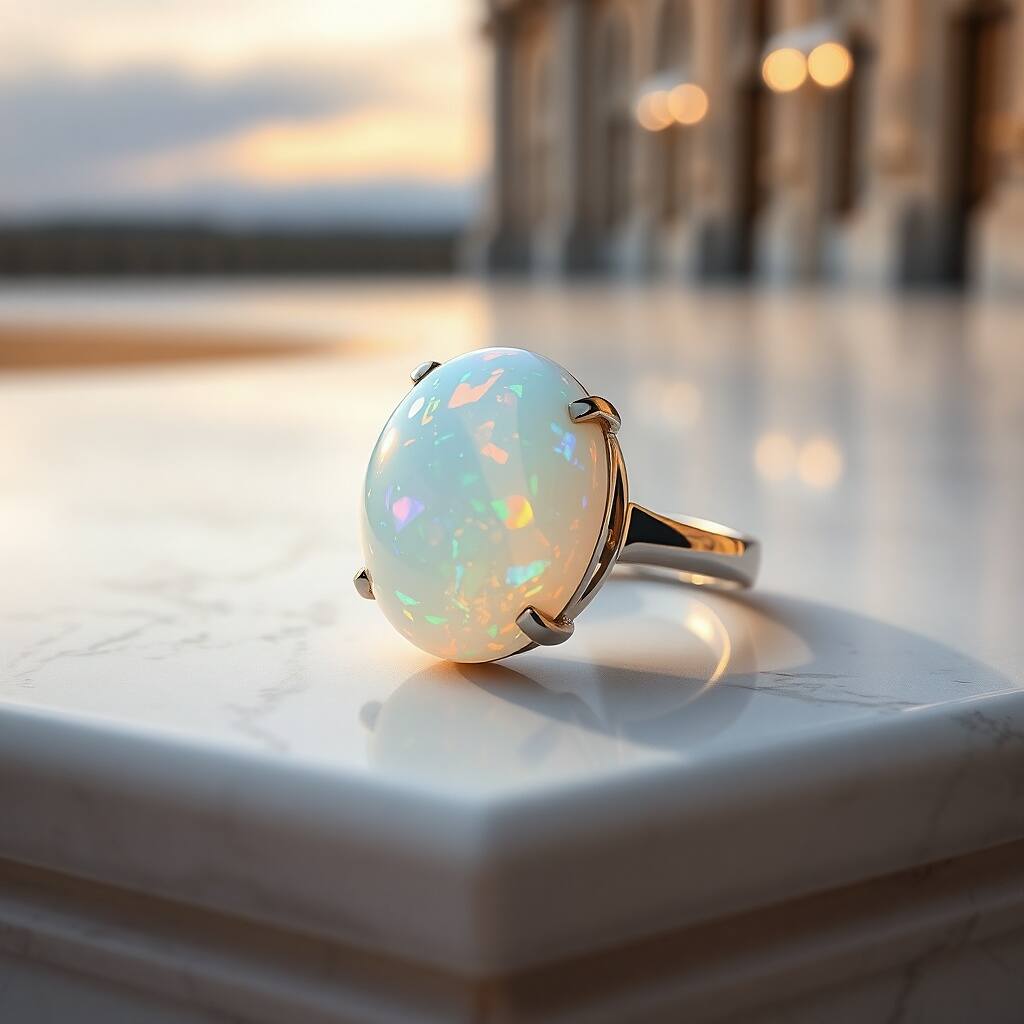
The opal motherhood love process is scientifically unique in the world of gemstones. Opal is not a crystal in the traditional sense; it is an amorphous hydrated silica. Essentially, it is water trapped within a silica structure. This lack of a rigid crystal lattice allows for the famous “play of colors” known as opalescence. In mineralogy, opal is often seen as an anomaly because it embraces softness and change. Understanding opal motherhood love means appreciating that beauty does not always require a rigid structure. True resilience is found in the ability to hold water—the liquid of life—within a solid form.
In addition, the opal motherhood love connection serves as a powerful family barometer. As a mother living in France, I received an opal ring from my two sons. They learned to read the “weather” of my soul through the stone’s shifting hues. For example, cold blue tones might signal fatigue, while warm golden sparks mean peace and joy. By practicing opal motherhood love, we teach our children to approach others with empathy and understanding. This mineral is a mirror of our internal tides. It reminds us that our mood is not a static state, but a flowing history of experiences and feelings.
Finally, finding your own opal motherhood-love helps you heal after life’s tectonic shifts. Just as opal forms in the cracks left by erosion after heavy rains, our new strength grows in the gaps of a broken heart. In the quiet dusk of Versailles, the glow of an opal represents a woman’s capacity to adapt and shine in every color. Please visit my Malachite Peace section to find more inspiration on emotional balance. The opal-motherhood-love within you is your truest currency. It is a light that remains constant even when life feels amorphous and uncertain.
Opal: A Barometer of the Mother’s Heart and a Liquid History of Love
In the world of mineralogy, the one where I spent my young engineering years in Vancouver, opal was defined as an anomaly. It is not a crystal in the strict sense of the word; it is an amorphous hydrated silica. Simply put: it is water trapped in the embrace of silica. While a diamond proudly displays its impenetrable lattice, the opal preserves softness, chaos, and change within itself.
I observed it through a microscope for a long time, admiring that “play of colors” that we engineers call opalescence. However, it was only years later, as I walked the streets of Paris carrying the scars of “tectonic disturbances”—divorce, illness, and moving—that I realized opal is not just a stone. It is a mirror.
It all began one May, when my two sons bought me an opal ring for Mother’s Day. They knew nothing about its chemical composition, nor that the stone was formed by slow sedimentation in rock crevices after heavy rains. To them, it was just a “magic little stone” that catches the rainbow. But that gift became the most important instrument in our house.
It became our family barometer. In the bright sun, I would lift my hand and show them how fires were lit inside the stone. “Look carefully,” I would tell them, and their small faces would light up as they watched for the reflection. “If you see bluish and cold tones, or if the stone becomes somehow greenish and sharp, it means that Mom might be a bit tired today, maybe angry, or her soul is in some internal rain of its own. But, if it’s soft like that, milky white with warm golden sparks… then everything is fine. Then Mom is at peace.”
There was something incredibly touching about how the two of them took that task seriously. I would often catch their gazes directed at my finger before they asked me anything. They would check the color of my heart through that little stone before throwing themselves into my embrace. Opal became the stone of love for us, but not that cinematic, static love, but the real kind—which has its tides and ebbs, its mists, and its clear mornings.
The connection of the opal with my life in Paris, the city where I found my “Malachite Peace” after forty-five, is not accidental. Opal is, just like love, a liquid that has solidified but retained the memory of movement. It is proof that beauty does not have to be rigid. My tectonic changes—painful experiences that broke me—actually created “crevices” into which a new kind of love moved. Just as opal is created in the crevices left by erosion, so my new strength was created in the crevices of my broken heart.
Let’s imagine Versailles for a moment. Not the Versailles from tourist brochures, but my Versailles at dusk. The sun is slowly setting, casting a pink-gold light on the marble floors and heavy velvet curtains. In that corner, a large, raw opal on the table would not just be a decoration. It would be the heart of the room. Its milky depth would absorb that golden light, turning it into something deep and melancholic, yet immensely warm. In my “geology of the soul,” that opal represents female strength that is not manifested in hardness, but in the ability to adapt, to shine in all colors, and to remain beautiful even when “amorphous”—without clear boundaries, guided exclusively by love.
Love is, just like opal, sometimes up, sometimes down. Sometimes it is transparent and clear, and sometimes milky and confusing. But always, absolutely always, it has that foundation—that water of life that keeps us together.
Therefore, dear women, you who feel “broken,” who think that pressure and the rains of life have worn you out too much—remember the opal. Buy yourself an opal stone. Let it be a reminder to you. Every time you look at it, do not look only at jewelry. Look at the people who love you and whom you love. Remember those who look at the “color of your mood” not to judge you, but to understand you.
Find your peace in that play of colors. Because, at the end of the day, bank accounts and statuses are fleeting, but those small “lanterns” we leave for others—that smile when the stone is milky white—that is what remains. That is our real currency. I found mine in the gaze of my two sons and in the shimmer of a ring that carries my entire history. Be like the opal: allow yourself to change colors, but never forget that at your core, you carry pure love.
Be like the opal: allow yourself to change colors, but never forget that at your core, you carry pure love. True beauty is found in the ability to shine even when you are amorphous.
L’Opale : Baromètre du cœur d’une mère et histoire liquide de l’amour
Dans le monde de la minéralogie, celui où j’ai passé mes jeunes années d’ingénieure à Vancouver, l’opale était définie comme une anomalie. Elle n’est pas un cristal au sens strict du terme ; elle est une silice hydratée amorphe. Plus simplement : elle est de l’eau emprisonnée dans l’étreinte de la silice. Alors que le diamant affiche fièrement son réseau impénétrable, l’opale préserve en elle la douceur, le chaos et le changement.
Je l’ai observée longtemps au microscope, admirant ce « jeu de couleurs » que nous, ingénieurs, appelons opalescence. Pourtant, ce n’est que des années plus tard, alors que je marchais dans les rues de Paris en portant les cicatrices des « perturbations tectoniques » — divorce, maladie et déménagement — que j’ai réalisé que l’opale n’est pas seulement une pierre. C’est un miroir.
Tout a commencé un mois de mai, quand mes deux fils m’ont offert une bague avec une opale pour la fête des mères. Ils ne savaient rien de sa composition chimique, ni que cette pierre était née de la sédimentation lente dans les fissures des roches après de grandes pluies. Pour eux, c’était juste une « petite pierre magique » qui attrape l’arc-en-ciel. Mais ce cadeau est devenu l’instrument le plus important de notre maison.
Elle est devenue notre baromètre familial. Sous le soleil éclatant, je levais la main et leur montrais comment des feux s’allumaient à l’intérieur de la pierre. « Regardez attentivement », leur disais-je, et leurs petits visages s’illuminaient. « Si vous voyez des tons bleutés et froids, ou si la pierre devient un peu verdâtre et tranchante, cela signifie que maman est peut-être un peu fatiguée aujourd’hui, peut-être en colère, ou que son âme est sous sa propre pluie intérieure. Mais, si elle est ainsi douce, d’un blanc laiteux avec des étincelles dorées et chaudes… alors tout va bien. Alors maman est en paix. »
Il y avait quelque chose d’incroyablement touchant dans la façon dont tous les deux prenaient cette tâche au sérieux. Je surprenais souvent leurs regards dirigés vers mon doigt avant qu’ils ne me demandent quoi que ce soit. Ils vérifiaient la couleur de mon cœur à travers ce petit caillou avant de se jeter dans mes bras. L’opale est devenue pour nous la pierre de l’amour, pas cet amour de cinéma, statique, mais le vrai — celui qui a ses marées et ses reflux, ses brouillards et ses matins clairs.
Le lien de l’opale avec ma vie à Paris, la ville où j’ai trouvé ma « Paix Malachite » après quarante-cinq ans, n’est pas le fruit du hasard. L’opale est, tout comme l’amour, un liquide qui s’est solidifié, mais qui a gardé la mémoire du mouvement. Elle est la preuve que la beauté n’a pas besoin d’être rigide. Mes changements tectoniques — les expériences douloureuses qui m’ont brisée — ont en fait créé des « fissures » dans lesquelles s’est installé un nouveau type d’amour. Tout comme l’opale se forme dans les fissures laissées par l’érosion, ma nouvelle force s’est créée dans les fissures de mon cœur brisé.
Imaginons un instant Versailles. Pas le Versailles des brochures touristiques, mais mon Versailles au crépuscule. Le soleil se couche lentement, projetant une lumière rose-dorée sur les sols de marbre et les lourds rideaux de velours. Dans ce coin, une grande opale brute sur la table ne serait pas seulement un décor. Elle serait le cœur de la pièce. Sa profondeur laiteuse absorberait cette lumière dorée, la transformant en quelque chose de profond et mélancolique, mais de pourtant immensément chaud. Dans ma « géologie de l’âme », cette opale représente la force féminine qui ne se manifeste pas par la dureté, mais par la capacité à s’adapter, à briller de toutes les couleurs et à rester belle même quand elle est « amorphe » — sans limites claires, guidée exclusivement par l’amour.
L’amour est, tout comme l’opale, parfois en haut, parfois en bas. Parfois transparent et clair, parfois laiteux et déroutant. Mais toujours, absolument toujours, il a cette base — cette eau de vie qui nous maintient ensemble.
C’est pourquoi, chères femmes, vous qui vous sentez « brisées », qui pensez que la pression et les pluies de la vie vous ont trop usées — souvenez-vous de l’opale. Achetez-vous une pierre d’opale. Qu’elle soit pour vous un rappel. Chaque fois que vous la regarderez, ne regardez pas seulement un bijou. Regardez les gens qui vous aiment et que vous aimez. Souvenez-vous de ceux qui regardent la « couleur de votre humeur » non pas pour vous juger, mais pour vous comprendre.
Trouvez votre paix dans ce jeu de couleurs. Car, à la fin de la journée, les comptes bancaires et les statuts sont éphémères, mais ces petites « lanternes » que nous laissons aux autres — ce sourire quand la pierre est blanc laiteux — c’est ce qui reste. C’est notre véritable monnaie. J’ai trouvé la mienne dans le regard de mes deux fils et dans les reflets d’une bague qui porte toute mon histoire. Soyez comme l’opale : permettez-vous de changer de couleurs, mais n’oubliez jamais que dans votre noyau, vous portez l’amour pur.
Soyez comme l’opale : permettez-vous de changer de couleurs, mais n’oubliez jamais que dans votre noyau, vous portez l’amour pur. La vraie beauté se trouve dans la capacité à briller même quand on est amorphe.
Opal: Barometar majčina srca i tekuća povijest ljubavi
U svijetu mineralogije, onom u kojem sam provela svoje mlade inženjerske godine u Vancouveru, opal je bio definiran kao anomalija. On nije kristal u strogom smislu riječi; on je amorfni hidratizirani silicijev dioksid. Jednostavnije rečeno: on je voda zarobljena u zagrljaju silicija. Dok dijamant ponosno ističe svoju neprobojnu rešetku, opal u sebi čuva mekoću, kaos i promjenu.
Dugo sam ga promatrala kroz mikroskop, diveći se toj “igri boja” koju mi inženjeri zovemo opalescencija. No, tek godinama kasnije, kada sam koračala pariškim ulicama noseći na sebi ožiljke “tektonskih poremećaja” – razvoda, bolesti i selidbe – shvatila sam da opal nije samo kamen. On je ogledalo.
Sve je počelo jednog svibnja, kada su mi moja dvojica sinova za Majčin dan kupili prsten s opalom. Nisu znali ništa o njegovom kemijskom sastavu, niti o tome da je taj kamen nastao polaganim taloženjem u pukotinama stijena nakon velikih kiša. Njima je on bio samo “čarobni kamenčić” koji hvata dugu. Ali taj dar postao je najvažniji instrument u našoj kući.
Postao je naš obiteljski barometar. Na jarkom suncu, podizala bih ruku i pokazivala im kako se unutar kamena pale vatre. „Gledajte pažljivo,“ govorila bih im, a njihova mala lica bi se ozarila dok bi vrebale odsjaj. „Ako vidite plavkaste i hladne tonove, ili ako kamen postane nekako zelenkast i oštar, to znači da je mama danas možda malo umorna, možda ljuta, ili joj je duša u nekoj svojoj unutrašnjoj kiši. Ali, ako je onako mekan, mliječno bijel sa toplim zlatnim iskrama… onda je sve u redu. Tada je mama u miru.“
Bilo je nešto nevjerojatno dirljivo u tome kako su njih dvojica ozbiljno shvatili taj zadatak. Često bih uhvatila njihove poglede usmjerene ka mom prstu prije nego što bi me bilo što pitali. Provjeravali bi boju mog srca kroz taj kamenčić prije nego što bi se bacili u moj zagrljaj. Opal je za nas postao kamen ljubavi, ali ne one filmske, statične ljubavi, već one prave – koja ima svoje plime i oseke, svoje magle i svoja bistra jutra.
Povezanost opala s mojim životom u Parizu, gradu u kojem sam pronašla svoj “Malachite Peace” nakon četrdeset i pete, nije slučajna. Opal je, baš kao i ljubav, tekućina koja se skrutnula, ali je zadržala sjećanje na pokret. On je dokaz da ljepota ne mora biti kruta. Moje tektonske promjene – bolna iskustva koja su me lomila – zapravo su stvorila “pukotine” u koje se uselila nova vrsta ljubavi. Baš kao što se opal stvara u pukotinama koje ostavlja erozija, tako se i moja nova snaga stvorila u pukotinama mog slomljenog srca.
Zamislimo na trenutak Versailles. Ne onaj Versailles iz turističkih brošura, već onaj moj Versailles u sumrak. Sunce polako zalazi, bacajući ružičasto-zlatnu svjetlost na mramorne podove i teške baršunaste zavjese. U tom kutku, jedan veliki, sirovi opal na stolu ne bi bio samo ukras. On bi bio srce sobe. Njegova mliječna dubina upijala bi tu zlatnu svjetlost, pretvarajući je u nešto duboko i melankolično, a opet neizmjerno toplo. U mojoj “geologiji duše”, taj opal predstavlja žensku snagu koja se ne očituje u tvrdoći, već u sposobnosti da se prilagodi, da zasja u svim bojama i da ostane lijepa čak i kad je “amorfna” – bez jasnih granica, vođena isključivo ljubavlju.
Ljubav je, baš kao opal, nekad gore, nekad dolje. Nekad je prozirna i jasna, a nekad mliječna i zbunjujuća. Ali uvijek, baš uvijek, ona ima tu osnovu – tu vodu života koja nas drži na okupu.
Zato, drage žene, vi koje se osjećate “polomljeno”, koje mislite da su vas pritisak i životne kiše previše istrošili – sjetite se opala. Kupite sebi jedan kamen opala. Neka vam on bude podsjetnik. Svaki put kad pogledate u njega, ne gledajte samo u nakit. Gledajte u ljude koji vas vole i koje vi volite. Sjetite se onih koji gledaju u “boju vašeg raspoloženja” ne da bi vas osudili, već da bi vas razumjeli.
Pronađite svoj mir u toj igri boja. Jer, na kraju dana, bankovni računi i statusi su prolazni, ali ti mali “fenjeri” koje ostavljamo drugima – taj osmijeh kad je kamen mliječno bijel – to je ono što ostaje. To je naša prava valuta. Ja sam svoju pronašla u pogledu svoja dva sina i u prelijevanju jednog prstena koji nosi cijelu moju povijest. Budite kao opal: dopustite si da mijenjate boje, ali nikada ne zaboravite da u svojoj jezgri nosite čistu ljubav.
Budite kao opal: dopustite si da mijenjate boje, ali nikada ne zaboravite da u svojoj jezgri nosite čistu ljubav. Prava ljepota se nalazi u sposobnosti da sjajite čak i kada ste amorfni.