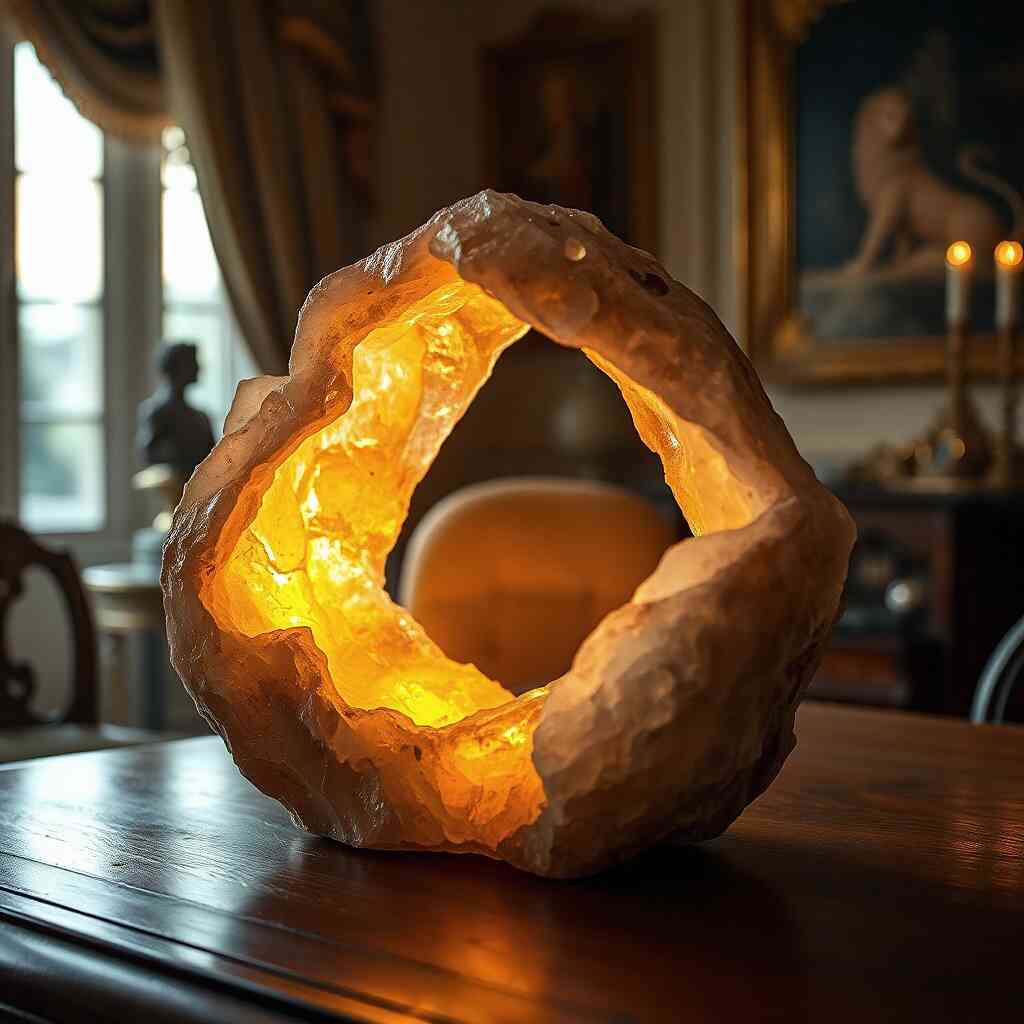
Gypsum crust the silent shield that protects a lion’s heart. In soul geology, we understand that silence is not a wall. It is a protective layer that guards our deepest vulnerability. We often feel the need to explain ourselves to everyone. We want the world to understand our pain. But sometimes, the best defense is the Gypsum crust our own silence. It is a soft but firm boundary that keeps the chaos away. By choosing when to speak, we protect our Malachite Peace from those who do not deserve our truth.
Gipsana kora i lavlje srce: Zašto šutnja nije zid, nego štit
U svijetu mineralogije, gips je fascinantan. On je mekan, on je hidratizirani kalcijev sulfat koji se može ogrebati noktom, ali u prirodi on tvori goleme, veličanstvene kristale koji izdržavaju stoljeća. Moja duša je upravo takva – gipsana kora koja na prvi pogled djeluje čvrsto i neprobojno, ali ispod te površine krije se jezgra koja se na toplu riječ odmah raznježi.
Dugo sam se pitala zašto se toliko trudim sakriti svoje osjećaje. Zašto biram tišinu umjesto vapaja? Odgovor leži u tektonskim poremećajima mog djetinjstva. Još kao mala djevojčica, naučila sam lekciju koju mnoga osjetljiva djeca nauče prebrzo: izdaja dolazi od onih kojima se otvoriš. Ispričati nekome što ti smeta ili što te boli često je značilo dati im oružje u ruke kojim će te poslije posjeći. Tako sam, sloj po sloj, gradila svoju gipsanu školjku. Naučila sam da je sigurnije šutjeti, jer savjet koji mi drugi mogu dati, ionako već nosim u svojoj glavi.
Ta moja empatija, ta “gipsana poroznost”, bila je moj blagoslov i moje prokletstvo. Godinama sam bila rezervoar za tuđe sudbine. Ljudi bi mi prilazili, osjetili tu moju mekoću i istresali svoje teške priče, svoje poraze i svoje tuge u mene. Ja bih te priče upijala, plakala bih više nego oni sami, proživljavala bih njihovu bol dok ne bih osjetila da ću puknuti od težine tuđeg tereta. A kad bi meni trebao izlaz? Kad bi meni trebala ruka utjehe?
Tada bih se povukla u svoju pećinu. Kao ranjena lavica, sama bih lizala svoje rane. Nisam htjela opterećivati druge, ne zato što ih nisam voljela, nego zato što sam znala da je put do iscjeljenja ionako samotan. Znala sam da uzaludno pričam onima koji ne čuju frekvenciju moje boli. Vancouver, Pariz, inženjerski nacrti ili pjesnički memoari – scenografija se mijenjala, ali moja potreba da samu sebe “popravim” ostala je ista.
Međutim, život u 45-oj donio je novi element u moju geološku kartu. Donio je istinsku ljubav. Sa svojim mužem prvi put ne moram biti samo “kora”. Njemu govorim istinu, njemu otvaram srce bez straha da će me to koštati energije. On me razumije čak i onda kada mu kažem: “Pusti me, moram ovo sama preživjeti.” On me ne forsira, on me čeka. On me ne crpi; on je izvor koji me puni, baš kao što me puni moje pisanje. Što više dajem, to se više osjećam cijelom.
Mnogi me pitaju: “Sanja, što bi se dogodilo s tvojim mirom, tom tvojom Malahitnom tišinom (Malachite Peace), kada bi dopustila da te netko do kraja povrijedi?” Odgovor je jednostavan, a ujedno i strašan u svojoj snazi. Prvo bih se dobro isplakala. Suze bi isprale prašinu gipsa. A nakon tog plača, ne bih ostala slomljena. Ustala bih, ispravila leđa i krenula opet onim svojim jakim, sigurnim korakom prema pobjedi i zdravlju. Jer lavica ne prestaje biti lavica samo zato što je ranjena. Ona samo uči kako se još bolje boriti.
Moja šutnja nije moj zatvor. Ona je moj laboratorij u kojem prerađujem bol u poeziju. Moja gipsana kora je tu da zaštiti ono najsvetije – sposobnost da volim bez zadrške, ali samo onda kada osjetim da je tlo pod mojim nogama stabilno.
La croûte de gypse et le cœur de lionne : Pourquoi le silence n’est pas un mur, mais un bouclier
Dans le monde de la minéralogie, le gypse est fascinant. Il est tendre, c’est un sulfate de calcium hydraté que l’on peut rayer avec l’ongle, mais dans la nature, il forme des cristaux immenses et magnifiques qui résistent aux siècles. Mon âme est exactement comme ça – une croûte de gypse qui semble solide et impénétrable à première vue, mais sous cette surface se cache un noyau qui s’attendrit immédiatement à un mot chaleureux.
Je me suis longtemps demandé pourquoi je faisais tant d’efforts pour cacher mes sentiments. Pourquoi je choisis le silence plutôt que les larmes ? La réponse réside dans les bouleversements tectoniques de mon enfance. Dès mon plus jeune âge, j’ai appris une leçon que beaucoup d’enfants sensibles apprennent trop vite : la trahison vient de ceux à qui l’on s’ouvre. Raconter à quelqu’un ce qui te dérange ou ce qui te blesse signifiait souvent lui donner une arme avec laquelle il te transpercerait plus tard. C’est ainsi que, couche par couche, j’ai construit ma coquille de gypse. J’ai appris qu’il était plus sûr de se taire, car les conseils que les autres peuvent me donner, je les porte déjà dans ma tête.
Cette empathie qui est la mienne, cette “porosité du gypse”, a été ma bénédiction et ma malédiction. Pendant des années, j’ai été un réservoir pour les destins des autres. Les gens m’approchaient, ressentaient ma douceur et déversaient en moi leurs lourdes histoires, leurs défaites et leurs chagrins. J’absorbais ces histoires, je pleurais plus qu’eux, je vivais leur douleur jusqu’à sentir que j’allais éclater sous le poids du fardeau d’autrui. Mais quand c’était moi qui avais besoin d’une issue ? Quand c’était moi qui avais besoin d’une main réconfortante ?
Alors, je me retirais dans ma grotte. Comme une lionne blessée, je léchais mes plaies seule. Je ne voulais pas accabler les autres, non pas parce que je ne les aimais pas, mais parce que je savais que le chemin de la guérison est de toute façon solitaire. Je savais qu’il était vain de parler à ceux qui n’entendent pas la fréquence de ma douleur. Vancouver, Paris, plans d’ingénierie ou mémoires poétiques – le décor changeait, mais mon besoin de me “réparer” moi-même restait le même.
Cependant, la vie à 45 ans a apporté un nouvel élément à ma carte géologique. Elle a apporté l’amour véritable. Avec mon mari, pour la première fois, je ne dois pas être seulement une “croûte”. À lui, je dis la vérité, à lui j’ouvre mon cœur sans craindre que cela me coûte de l’énergie. Il me comprend même quand je dis : “Laisse-moi, je dois traverser ça toute seule.” Il ne me force pas, il m’attend. Il ne m’épuise pas ; il est une source qui me remplit, tout comme mon écriture me remplit. Plus je donne, plus je me sens entière.
Beaucoup me demandent : “Sanja, qu’adviendrait-il de ta paix, de cette paix de Malachite (Malachite Peace), si tu laissais quelqu’un te blesser profondément ?” La réponse est simple, et en même temps terrible dans sa force. D’abord, je pleurerais un bon coup. Les larmes laveraient la poussière du gypse. Et après ces pleurs, je ne resterais pas brisée. Je me lèverais, je redresserais le dos et je repartirais de ce pas fort et assuré vers la victoire et la santé. Car une lionne ne cesse pas d’être une lionne simplement parce qu’elle est blessée. Elle apprend juste à se battre encore mieux.
Mon silence n’est pas ma prison. Il est mon laboratoire où je transforme la douleur en poésie. Ma croûte de gypse est là pour protéger ce qu’il y a de plus sacré – la capacité d’aimer sans retenue, mais seulement quand je sens que le sol sous mes pieds est stable.
Gypsum Crust and a Lioness’s Heart: Why Silence is Not a Wall, But a Shield
In the world of mineralogy, gypsum is fascinating. It is soft, a hydrated calcium sulfate that can be scratched with a fingernail, but in nature, it forms massive, magnificent crystals that withstand centuries. My soul is exactly like that—a gypsum crust that at first glance seems solid and impenetrable, but beneath that surface hides a core that immediately softens at a warm word.
For a long time, I wondered why I tried so hard to hide my feelings. Why do I choose silence over cries? The answer lies in the tectonic shifts of my childhood. Even as a little girl, I learned a lesson that many sensitive children learn too quickly: betrayal comes from those you open up to. Telling someone what bothers you or what hurts you often meant handing them a weapon they would later use to cut you. And so, layer by layer, I built my gypsum shell. I learned that it is safer to stay silent because the advice others might give me, I already carry in my own head.
This empathy of mine, this “gypsum porosity,” was my blessing and my curse. For years, I was a reservoir for other people’s destinies. People would approach me, sense my softness, and pour out their heavy stories, their defeats, and their sorrows into me. I would absorb those stories, cry more than they did themselves, and live through their pain until I felt I would burst from the weight of someone else’s burden. But what when I needed a way out? When I needed a comforting hand?
Then I would retreat into my cave. Like a wounded lioness, I would lick my wounds alone. I didn’t want to burden others, not because I didn’t love them, but because I knew that the path to healing is solitary anyway. I knew it was futile to speak to those who do not hear the frequency of my pain. Vancouver, Paris, engineering blueprints, or poetic memoirs—the scenery changed, but my need to “fix” myself remained the same.
However, life at 45 brought a new element to my geological map. It brought true love. With my husband, for the first time, I don’t have to be just a “crust.” To him, I speak the truth; to him, I open my heart without fear that it will cost me energy. He understands me even when I tell him, “Leave me be, I have to survive this alone.” He doesn’t force me; he waits for me. He doesn’t drain me; he is a spring that fills me, just as my writing fills me. The more I give, the more whole I feel.
Many ask me: “Sanja, what would happen to your peace, to that Malachite Peace of yours, if you allowed someone to hurt you to the core?” The answer is simple, yet terrifying in its strength. First, I would cry my heart out. The tears would wash away the gypsum dust. And after that crying, I would not remain broken. I would stand up, straighten my back, and set off again with that strong, confident step of mine toward victory and health. Because a lioness doesn’t stop being a lioness just because she is wounded. She only learns how to fight even better.
My silence is not my prison. It is my laboratory where I process pain into poetry. My gypsum crust is there to protect what is most sacred—the ability to love without holding back, but only when I feel that the ground beneath my feet is stable.