The Art of Slowing Down:
How to Become a Gemstone in a Hurried World
The art of slowing down is best described as an invisible thread that connects the hurried child chasing butterflies and the wise person who, decades later, calmly observes an ant on a sunlit balcony. Notably, that thread is called time, but not the kind we measure with clocks—rather, the kind we measure by changes in our own core. Specifically, it is often thought that life is a race where the winner is the one who reaches the finish line first. Indeed, true magic actually hides in those moments when the run stops and the step becomes light and conscious.
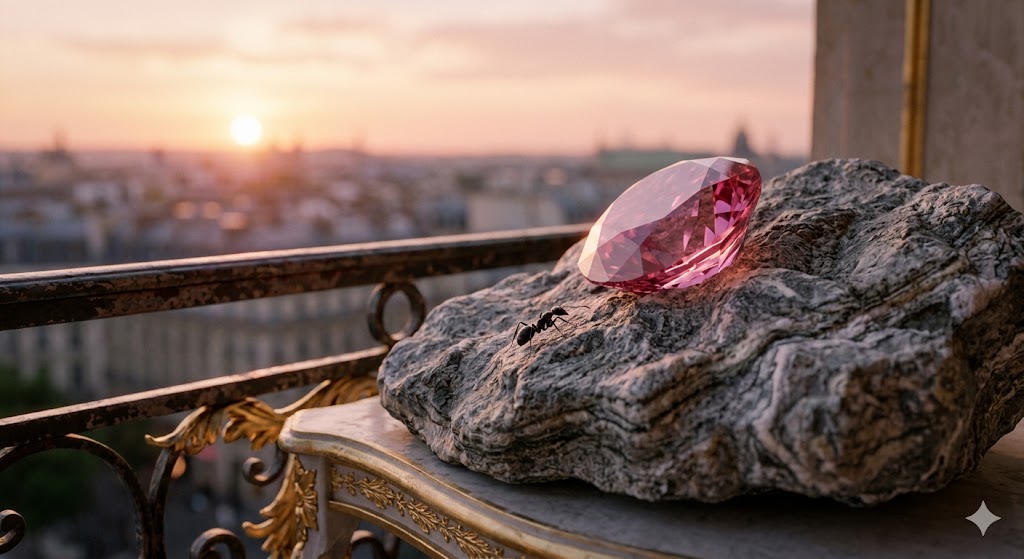
In a world that constantly rushes us—to respond to a message faster, to achieve goals earlier, to get answers to all our prayers immediately—the magnificent process of metamorphosis is forgotten. In geology, the most beautiful crystals, like spinel, do not form overnight. They are the result of Earth’s patience. Perfect balance of pressure and temperature is needed, but most importantly: undisturbed time. Spinel, that glassy gem that can be red like a heart or pink like the dawn, is a reminder that the internal structure changes only when we agree to the process of waiting. These glassy red and pink crystals would never reach their brilliant clarity without the art of slowing down.
From Magma to the Art of Slowing Down
Youth is magmatic by nature. Notably, it screams, erupts to the surface, and wants to change the world in one breath. In that period, waiting seems like a punishment. Specifically, waiting for new love, for a new beginning, or even for an ordinary salary, looks like wasted time. But with years, that boiling magma cools and settles. Consequently, one begins to realize that every “wait” is actually not an obstacle, but a space to practice the art of slowing down.
Slowing down is not a loss of speed; it is a gain in depth. Notably, when the rhythm of life slows, the field of vision paradoxically expands. Specifically, instead of looking at the distant horizon that constantly escapes, the gaze lowers to what is directly in front of us. It could be a bug exploring the edge of a flower pot or the play of light on an old stone wall. In that moment, the burden of the past and the uncertainty of the future vanish. Consequently, only “now” remains—that golden section of existence that defines the art of slowing down.
Beauty in the Art of Slowing Down
There is something deeply liberating in knowing that we don’t have to be everywhere at once. Notably, life teaches us seriousness, but not the dark and heavy kind, rather that dignified seriousness of a mineral that knows its value. This maturity brings the art of slowing down into our very core. Consequently, it brings a peace that no longer depends on external successes. Indeed, it is that feeling when a smile no longer arises from big victories, but from tiny, everyday miracles.
Golden moments are those in which we are completely present. Specifically, the melancholy that sometimes accompanies them is not sadness, but a gentle acknowledgment that time flows. Notably, it is like the pink reflection on spinel—it gives it color, depth, and character. Without this flow of time, there would be no beauty. Real happiness is not found in waiting for what is yet to come, but in the cessation of waiting. Consequently, the moment we stop looking for happiness in tomorrow, it appears like a small ant on our balcony, reminding us that the entire universe is contained in the art of slowing down.
The Art of Slowing Down on the Balcony
Observing nature, its smallest inhabitants and its hardest rocks, means learning about oneself. Notably, nature never hurries, yet it achieves everything. Specifically, a flower does not try to bloom faster than the one next to it; a rock does not complain about standing in the same place for millennia. Indeed, they simply are.
When we adopt this philosophy, life becomes light. Specifically, there is no longer a need for proving, for eternal competition with time. Notably, we become observers of our own metamorphosis. We realize that every phase was necessary—both that impatient, volcanic youth, and these calm, crystalline days. Therefore, every moment in which we thought we were “wasting time” waiting, we were actually building ourselves from within, changing our chemical composition into something firmer, clearer, and brighter.
The most beautiful gemstone is the one that has learned to be still.
Life is the slow, quiet walk of a bug on a warm stone.
Life is happening precisely now.
Life is the slow, quiet walk of a bug on a warm stone.
Life is happening precisely now.
L’art de ralentir :
Comment devenir une pierre précieuse dans un monde pressé
L’art de ralentir (the art of slowing down) est un fil invisible qui relie l’enfant pressé courant après les papillons et la personne sage qui, des décennies plus tard, observe calmement une fourmi sur un balcon ensoleillé. Notamment, ce fil s’appelle le temps, mais pas celui que nous mesurons avec des horloges—plutôt celui que nous mesurons par les changements au cœur de notre propre être. On pense souvent que la vie est une course où le gagnant est le premier à franchir la ligne d’arrivée, mais la vraie magie se cache en fait dans ces moments où la course s’arrête et où le pas devient léger et conscient.
Dans un monde qui nous bouscule constamment—pour répondre plus vite, atteindre les objectifs plus tôt, obtenir des réponses immédiates—on oublie le magnifique processus de la métamorphose. En géologie, les plus beaux cristaux, comme le spinelle, ne se forment pas du jour au lendemain. Ils sont le résultat de la patience de la Terre. Il faut un équilibre parfait de pression et de température, mais surtout : du temps ininterrompu. Le spinelle, cette gemme vitreuse qui peut être rouge comme un cœur ou rose comme l’aube, nous rappelle que la structure interne ne change que lorsque nous acceptons le processus d’attente. Ces cristaux roses et rouges n’atteindraient jamais leur clarté brillante sans l’art de ralentir.
Du Magma à l’art de ralentir
La jeunesse est magmatique par nature. Notamment, elle crie, jaillit à la surface, veut changer le monde d’un seul souffle. Dans cette période, l’attente semble être une punition. Spécifiquement, attendre un nouvel amour, un nouveau départ ou même un simple salaire semble être du temps perdu. Mais avec les années, ce magma bouillant se refroidit et se dépose. Par conséquent, on commence à comprendre que chaque « attend » n’est pas un obstacle, mais un espace pour respirer, une opportunité pour s’entraîner à l’art de ralentir.
Ralentir n’est pas une perte de vitesse ; c’est un gain en profondeur. Notamment, lorsque le rythme de la vie ralentit, le champ de vision s’élargit paradoxalement. Spécifiquement, au lieu de regarder l’horizon lointain qui s’échappe, le regard se pose sur ce qui est juste devant nous. À ce moment, le poids du passé et l’incertitude du futur disparaissent. En effet, il ne reste que le « maintenant » — cette section dorée de l’existence.
La Beauté dans l’art de ralentir
Il y a quelque chose de profondément libérateur à savoir que nous n’avons pas besoin d’être partout à la fois. Notamment, la vie nous enseigne le sérieux, mais pas celui sombre et lourd, plutôt le sérieux digne d’un minéral qui connaît sa valeur. Cette maturité apporte l’art de ralentir au plus profond de notre être. Par conséquent, elle apporte une paix qui ne dépend plus des succès extérieurs. En effet, c’est ce sentiment quand un sourire ne naît plus de grandes victoires, mais de minuscules miracles quotidiens.
Les moments dorés sont ceux où nous sommes totalement présents. Spécifiquement, la mélancolie qui les accompagne parfois n’est pas de la tristesse, mais une reconnaissance délicate que le temps coule. Notamment, c’est comme le reflet rose sur le spinelle — cela lui donne de la couleur, de la profondeur et du caractère. Le vrai bonheur se trouve dans l’arrêt de l’attente. En fait, dès que nous cessons de chercher le bonheur dans demain, il apparaît comme une petite fourmi sur notre balcon, nous rappelant que l’univers entier est contenu dans l’art de ralentir.
La Sagesse de l’art de ralentir sur le balcon
Observer la nature, ses plus petits habitants et ses roches les plus dures, signifie apprendre sur soi-même. Notamment, la nature ne se presse jamais, et pourtant elle accomplit tout. Spécifiquement, une fleur n’essaie pas de s’épanouir plus vite que sa voisine ; un rocher ne se plaint pas d’être au même endroit depuis des millénaires. En réalité, ils sont, tout simplement.
Lorsque nous adoptons cette philosophie, la vie devient légère. Spécifiquement, nous n’avons plus besoin de prouver, de rivaliser éternellement avec le temps. Notamment, nous devenons les observateurs de notre propre métamorphose. Nous comprenons que chaque phase était nécessaire — tant la jeunesse volcanique que ces jours cristallins et calmes. Par conséquent, chaque moment passé à « perdre son temps » à attendre était en fait une construction intérieure.
La plus belle pierre précieuse est celle qui a appris à être immobile.
La vie est la marche lente et silencieuse d’un insecte sur une pierre chaude.
La vie se passe précisément maintenant.
La vie est la marche lente et silencieuse d’un insecte sur une pierre chaude.
La vie se passe précisément maintenant.
Umjetnost usporavanja:
Kako postati dragi kamen u svijetu koji juri
Umjetnost usporavanja (the art of slowing down) je nevidljiva nit koja povezuje užurbano dijete koje trči za leptirima i mudru osobu koja, desetljećima kasnije, mirno promatra mrava na osunčanom balkonu. Značajno je da se ta nit zove vrijeme, ali ne ono koje mjerimo satovima, već ono koje mjerimo promjenama u vlastitoj srži. Točnije, često se misli da je život utrka u kojoj pobjeđuje onaj tko prvi stigne do cilja, no prava se magija zapravo krije u onim trenucima kada se trk zaustavi, a korak postane lagan i svjestan.
U svijetu koji nas stalno požuruje – da brže odgovorimo na poruku, da ranije ostvarimo ciljeve, da odmah dobijemo odgovore na sve svoje molitve – zaboravlja se na veličanstveni proces metamorfoze. U geologiji, najljepši kristali poput spinela ne nastaju preko noći. Oni su rezultat strpljenja Zemlje. Potrebna je savršena ravnoteža pritiska i temperature, ali i ono najvažnije: neometano vrijeme. Spinel, taj staklasti dragulj koji može biti crven poput srca ili ružičast poput zore, podsjetnik je da se unutarnja struktura mijenja tek kada pristanemo na proces čekanja. Ovi ružičasti i crveni kristali nikada ne bi postigli svoju sjajnu čistoću bez umjetnosti usporavanja.
Od magme do umjetnosti usporavanja
Mladost je po svojoj prirodi magmatska. Značajno je da ona vrišti, izbija na površinu, želi promijeniti svijet u jednom dahu. U tom periodu, čekanje se čini kao kazna. Točnije, čekanje na novu ljubav, na novi početak ili čak na običnu plaću, izgleda kao izgubljeno vrijeme. Ali s godinama, ta se uzavrela magma hladi i taloži. Slijedom toga, čovjek počinje shvaćati da svako „čekaj” zapravo nije prepreka, već prostor za disanje i vježbanje umjetnosti usporavanja.
Usporavanje nije gubitak brzine; to je dobivanje na dubini. Značajno je da se ritam života uspori, vidno polje se paradoksalno proširi. Točnije, umjesto da se gleda u daleki horizont koji stalno bježi, pogled se spušta na ono što je neposredno ispred nas. Može biti buba koja istražuje rub tegle s cvijećem ili igra svjetlosti na starom kamenom zidu. U tom trenutku, nestaje teret prošlosti i neizvjesnost budućnosti. Slijedom toga, ostaje samo „sada” – taj zlatni presjek postojanja.
Ljepota u umjetnosti usporavanja
Postoji nešto duboko oslobađajuće u saznanju da ne moramo biti svugdje odjednom. Značajno je da nas život uči ozbiljnosti, ali ne onoj mračnoj i teškoj, već onoj dostojanstvenoj ozbiljnosti minerala koji zna svoju vrijednost. Ova zrelost unosi umjetnost usporavanja u samu našu srž. Slijedom toga, donosi mir koji više ne ovisi o vanjskim uspjesima. Doista, to je onaj osjećaj kada se osmijeh više ne javlja zbog velikih pobjeda, već zbog sitnih, svakodnevnih čuda.
Zlatni trenuci su oni u kojima smo potpuno prisutni. Točnije, melankolija koja ih ponekad prati nije tuga, već nježno priznanje da vrijeme teče. Značajno je da je ona poput ružičastog odsjaja na spinelu – daje mu boju, dubinu i karakter. Bez tog protoka vremena, ne bi bilo ni ljepote. Prava sreća se ne nalazi u čekanju onoga što tek treba doći, već u prestanku čekanja. Slijedom toga, onog trena kada prestaneš tražiti sreću u sutrašnjem danu, ona se poput malog mrava pojavi na našem balkonu, podsjećajući nas da je cijeli svemir sadržan u umjetnosti usporavanja.
Mudrost umjetnosti usporavanja s balkona
Promatrati prirodu, njezine najmanje stanovnike i njezine najtvrđe stijene, znači učiti o sebi. Značajno je da priroda nikada ne žuri, a ipak sve postigne. Točnije, cvijet ne pokušava procvjetati brže od onog do sebe; stijena se ne buni što tisućljećima stoji na istom mjestu. Doista, oni jednostavno jesu.
Kada usvojimo tu filozofiju, život postaje lagan. Točnije, više nema potrebe za dokazivanjem, za vječnim natjecanjem s vremenom. Značajno je da postajemo promatrači vlastite metamorfoze. Shvaćamo da je svaka faza bila potrebna – i ona nestrpljiva, vulkanska mladost, i ovi mirni, kristalni dani. Slijedom toga, svaki trenutak u kojem smo mislili da „gubimo vrijeme” čekajući, zapravo smo se gradili iznutra, mijenjajući svoj kemijski sastav u nešto čvršće, bistrije i sjajnije.
Najljepši dragi kamen je onaj koji je naučio mirovati.
Život je onaj spori, tihi hod bube po toplom kamenu.
Život se događa upravo sada.
Život je onaj spori, tihi hod bube po toplom kamenu.
Život se događa upravo sada.
— 283 —